Major thanks to Phil Constantino, Project Executive at Fort Myer Construction Company in DC and CloudRig Advisor, for contributing to this guide.
For Pt. 1 (The Problem), see here
Contractors across the U.S.—from small sitework crews to enterprise-level heavy civil builders—all face the same challenge: keeping field, office, and finance aligned as they grow. At CloudRig, we’ve seen firsthand how the right construction management system evolves with each stage of a contractor’s journey.
Small
- $0–4M revenue
- 0–30 employees
Contractors in this range are likely running a few crews on a handful of jobs and self-performing a few services.
In this range, you’ll typically have an owner (who is often just working his way out of the field), a head of Ops and project management who also estimates and bids jobs, and an office manager responsible for getting payroll out the door and working with a CPA to keep the books in order.
Leadership can monitor performance in their heads—they know which of their crews are good at what kinds of work, and which jobs are making them money and which aren’t. They can succeed while bidding in Excel, tracking time using paper time cards or a basic timekeeping app, and figuring out the exact cost of jobs after the fact.
That said, we do have customers in this range who recognize that, if they’re going to add crews or services, it’s helpful to build the habits they’ll need across field and office to grow profitably. Better technology helps them to document sites, set production targets and review performance in real time, and monitor where they’re gaining and fading hours and profits across jobs and crews.
If you’re in this range and happy to stay there forever, spreadsheets and QuickBooks will serve. If you have aspirations to grow, read on to learn more about what you’ll need to put in place.
Key Takeaway:
Small contractors benefit from adopting early systems for field documentation, production tracking, and real-time reporting—tools that lay the foundation for scaling.
Key employees, responsibilities, and technology

Midsize
- $4–30M revenue
- 30–150 employees
Midsize contractors are running five to 15 crews at a time on more jobs than an exec can track in his head. They’re also often starting to take on more highly regulated public work and to perform services that haven’t traditionally been in their wheelhouse.
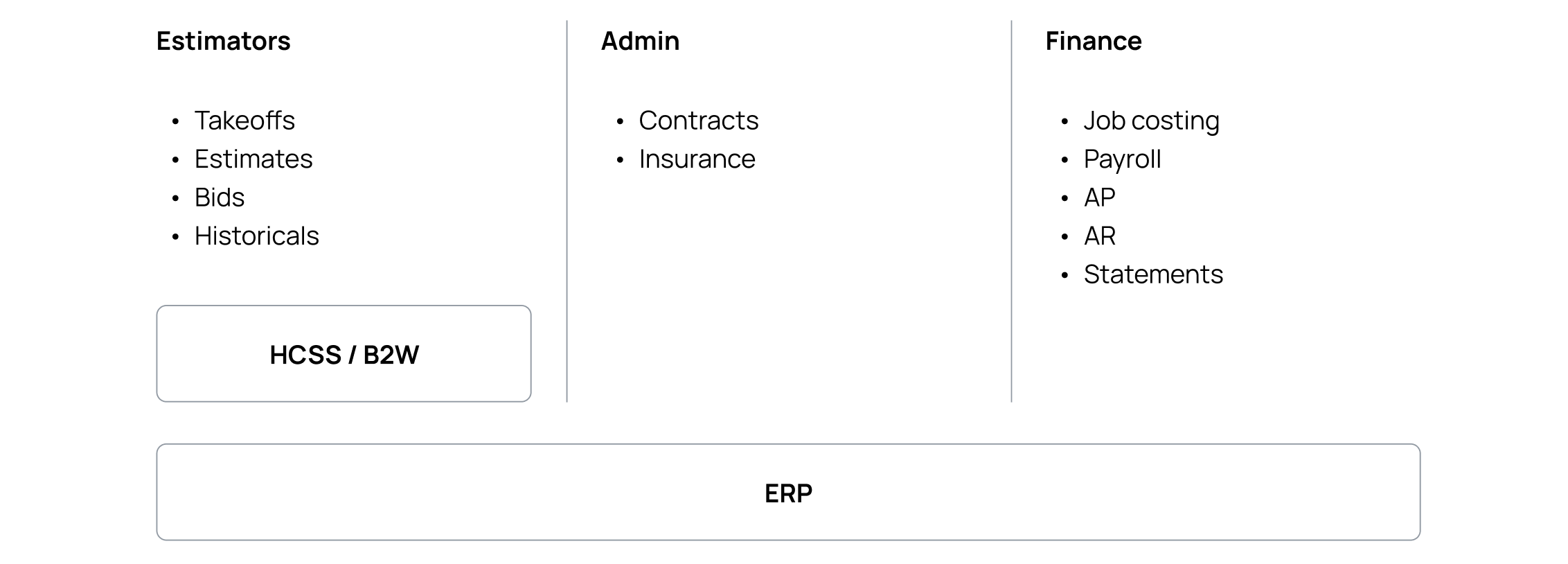
Their operations are more complex—they have dedicated PMs and estimators, a Finance function that brings bookkeeping in-house, and a chain of command for the field that distinguishes foremen and superintendents, reporting up to a general superintendent and head of Operations.
Smart contractors equip these new personnel with what we’ve termed a performance management system to unify project teams in pursuit of field and financial excellence. A performance management system isn’t just a field time card or quantity log. Rather, it’s a complete set of capabilities that allow Ops, PMs, and superintendents to:
- Set financial targets
- Tie them to production goals
- Build near-term lookaheads
- Review performance in real time
Without the ability to forecast, build, review, and repeat, companies struggle to identify, bid, and deliver profitable jobs for sophisticated clients in competitive markets.
The ERP plays a role, of course—this system must pull financial data from accounting so that PMs can monitor the financial impact of field performance. But today’s ERPs, with their clunky reporting tools, siloed data, and decrepit mobile interfaces, cannot serve as the daily operating system for office or field. Nor can generic field reporting tools that leave contractors to manage everything in the rearview.
The right system equips contractors to unify, plan for, and hit their field and financial targets.
A final note—at some point in this range, you’ll push QuickBooks to its breaking point—especially if you’re running QuickBooks Online rather than Desktop—and will need to think about graduating to a Foundation, Vista, Spectrum, or Sage. We’ve seen some 120-employee contractors manage payroll and job cost out of QuickBooks, but it’s a lot of work.
Key Takeaway:
Midsize contractors should prioritize performance management software that connects the field, office, and accounting. This stage is where CloudRig shines—bridging daily production reporting, forecasting, and ERP data without the friction.
Project Team: Key employees, responsibilities, and technology

Other Functions: Key employees, responsibilities, and technology
Large
- $30–100M revenue
- 150–500 employees
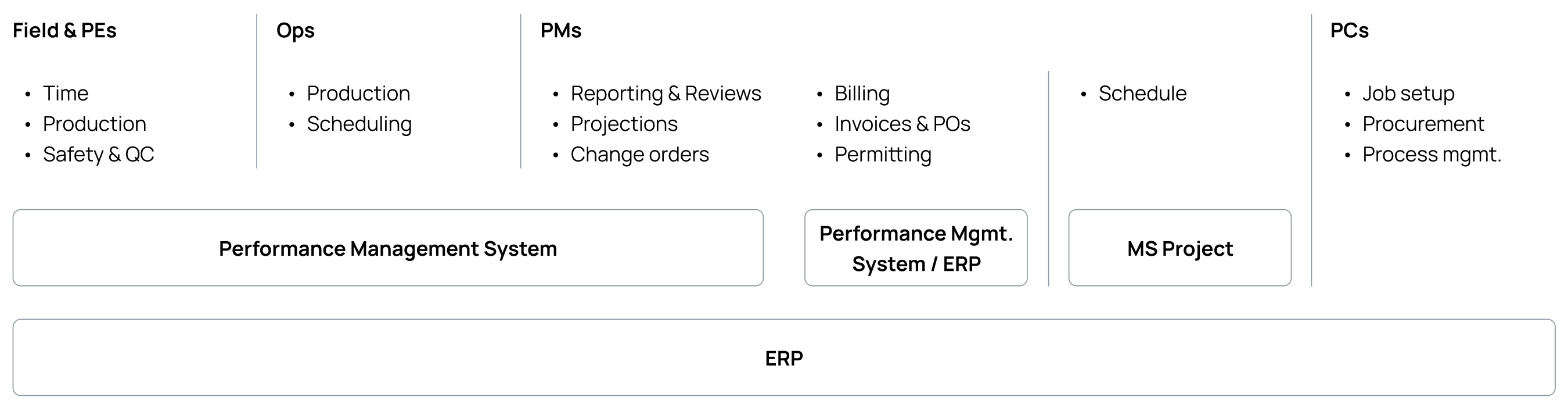
Large customers deliver a broader range of services for a mix of public and private clients. Typically, we see customers in this range investing more heavily in administrative functions in the form of project engineers and project coordinators to ensure that Ops, PMs, and the field can focus on delivering jobs rather than, for example, counting quantities, chasing documents, enforcing internal processes, or minding the ERP.
If you don’t already have a performance management system in place before growing into this stage, you’ll begin to feel serious pain now, as stacks of disconnected time cards, logs, and job cost reports pile up from the field and from finance without ever painting a clear picture of where you’re over-performing, underperforming, and why.
Getting this system in place quickly ensures you’ll max out your profits in good market conditions and know where to double down—or cut—in bad ones.
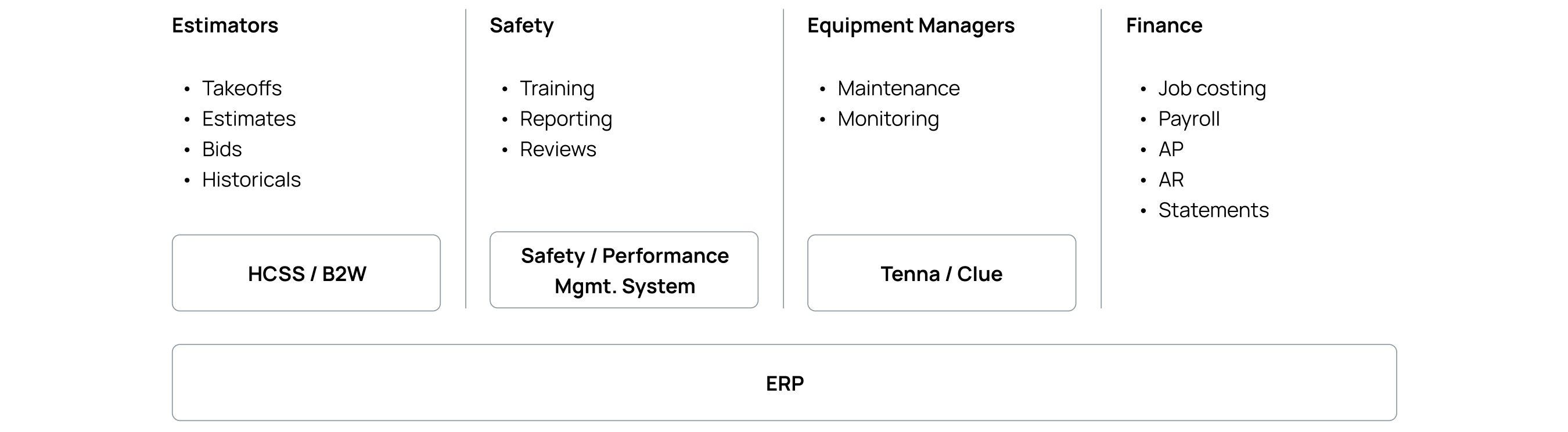
Finally, safety gets its own headcount in this range as contractors take on larger jobs with bonding and compliance requirements, as does asset management as fleets outgrow what a mechanic can manage from memory.
Again, ERPs have made a bid to manage all these capabilities. But while having a centralized equipment list in the ERP is important for job costing, ERPs will never serve as intelligent hubs for analyzing telemetry data, managing maintenance, or tracking utilization.
Key Takeaway:
At this level, success depends on connecting your ERP with purpose-built systems—for safety, fleet, and field performance—to make data actionable and ensure every job runs profitably.
Project Team: Key employees, responsibilities, and technology
Other Functions: Key employees, responsibilities, and technology
Enterprise
- $100M+ revenue
- 500+ employees
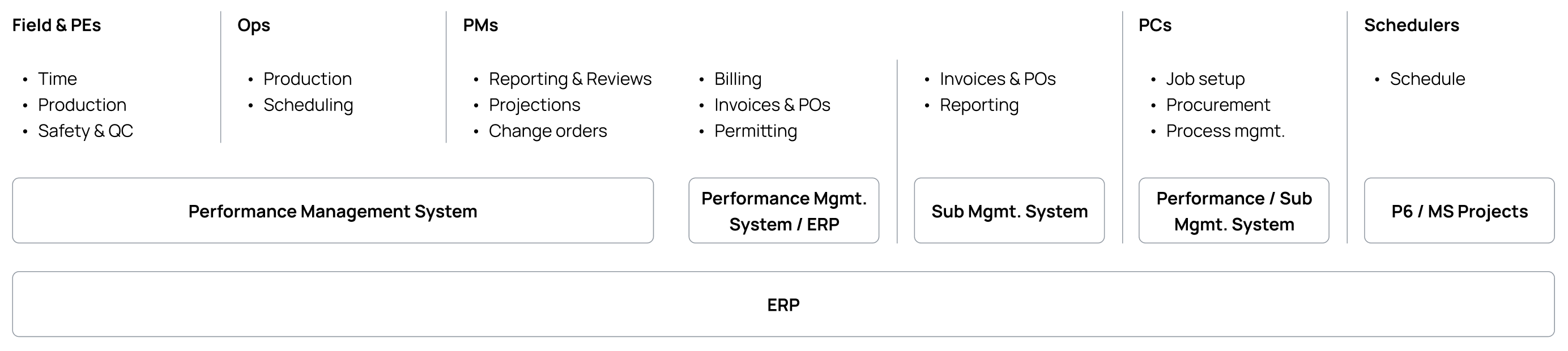
Enterprise contractors have a robust mix of GC and self-perform work, with all the complex subcontractor management—qualifying, contracting, monitoring, paying, etc.—that comes with it.
Contractors in this range have done well to adopt tools like Procore, originally built for commercial and residential GCs. But GC tools, which don’t allow companies to monitor budgets, actuals, and forecasts for quantities, hours, and cost, won’t fuel profits in the self-perform, unit-price, production-driven side of the business.
Contractors are best served finding a dedicated performance management system that connects both with the ERP and with the subcontractor management platform, solving self-perform and sub management problems with best-in-class integrations.
Key Takeaway:
Enterprise contractors need connected ecosystems—ERP + subcontractor + self-perform tools that create a unified, real-time view of operations and financial health.
Project Team: Key employees, responsibilities, and technology
Other Functions: Key employees, responsibilities, and technology

Wrapping It Up
So what’s the lesson for self-perform contractors? This isn’t another tired reflection on how contractors should buy more technology. It is, however, a call to get better at evaluating it.
Observers love bemoaning, “There’s too much technology in the market.” But the number of construction tech offerings is still smaller than what exists in industries like manufacturing, energy, or utilities. The reason there are so many contech vendors is because there are real opportunities to improve processes and return profits to contractors.
A few tools that each solve one problem well generate more value than one tool that solves all problems poorly—provided they integrate with your ERP.
It takes time and effort to find those tools. The real cost to contractors of getting the tech stack right isn’t the subscription fee—it’s the time and effort they spend finding and implementing the right systems.
At CloudRig, we’re passionate about solving the most critical problem faced by self-perform, production-driven contractors—identifying where you’re making money, losing money, and why in time for Ops, PMs, and superintendents to do something about it.